Emergency HVAC in Downtown LA

no cooling, heat event failures, rooftop access, air handler leaks, and urgent triage. This local page is written for Downtown LA homes and units where adaptive-reuse lofts, newer high-rise condos, older mixed-use buildings, live-work apartments can make a basic emergency call depend on access, shutoffs, panel condition, utility context, and inspection planning.

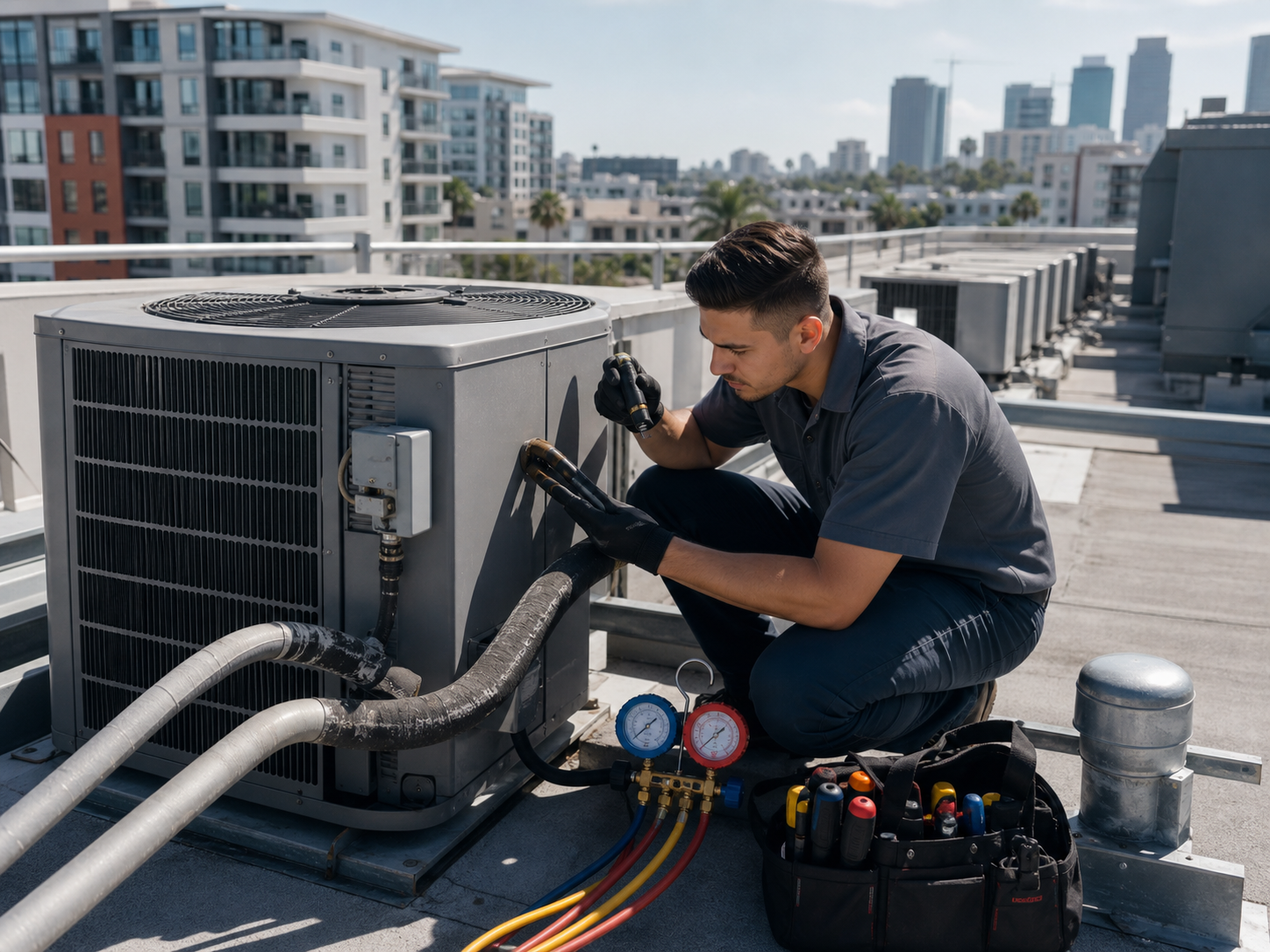
Technician inspecting rooftop HVAC equipment for a Los Angeles condo building

Quick answer for Downtown LA homeowners

Emergency HVAC in Downtown LA should start with a clear symptom, a clean access plan, and a realistic view of what can expand the scope. The visible problem may be Heat illness risk, Condensate overflow, Electrical shorts, but the visit can change when the building adds rooftop key control, concierge or property manager approvals, or loading-zone timing. In a older mixed-use buildings, the technician may need to reach the equipment, panel, drain, shutoff, cleanout, roof hatch, balcony, garage, or building manager before the real diagnostic work starts.

The most useful preparation is simple: book the dispatch window, add photos, list the exact symptom, note whether other units are affected, and confirm who controls the building areas. If the call involves no cooling, active leaking, burning smell, repeated breaker trips, water heater failure, or a backup that affects more than one fixture, treat it as urgent. If the symptom is stable, use the same process to plan a repair, replacement, or inspection-ready estimate without forcing an emergency premium.

Best first move

Book through the external form, then prepare these items: Turn off equipment if water or burning smell appears; Open roof or mechanical room access; Check breaker status once only; Move vulnerable occupants to a cooler room; Book the earliest access window. For Downtown LA, add access notes for loading-zone timing; elevator protection; rooftop key control; concierge or property manager approvals.

Why emergency HVAC repair is different in Downtown LA

Downtown LA sits in the Downtown and Central service cluster and is best understood as a urban core. Homes around Historic Core lofts, South Park towers, Arts District mixed-use blocks can combine adaptive-reuse lofts, newer high-rise condos, older mixed-use buildings, live-work apartments on the same few blocks. That mix matters because the same emergency HVAC repair call can require different equipment, ladder access, shutoff windows, service-hour approvals, or cleanup protection depending on the building. A newer high-rise may have strict elevator and engineer rules. An older apartment may have limited panel labeling and shared drain stacks. A converted building may hide old pipes, old wiring, or nonstandard mechanical routing behind newer finishes.

The local utility context is also part of the plan: LADWP electric and water service, with SoCalGas context where gas appliances remain. The permit and inspection context is LADBS plan check and inspection. For emergency hvac, the permit question is: Emergency diagnostics can often start before permit decisions; equipment replacement and major electrical changes should still be documented properly. That does not mean every small diagnostic requires a major permit process. It means the repair should be separated from permanent replacement, new circuit work, gas or venting changes, sewer or pipe work, equipment relocation, or any scope that changes the building system.

Downtown LA data-point snapshot

Reference points: Historic Core lofts; South Park towers; Arts District mixed-use blocks. Building mix: adaptive-reuse lofts; newer high-rise condos; older mixed-use buildings; live-work apartments. Access profile: loading-zone timing; elevator protection; rooftop key control; concierge or property manager approvals. Risk profile: shared risers; older electrical closets; rooftop HVAC access; after-hours leak containment; parking constraints. Seasonal operating context: extreme heat in upper-floor units; urban particulate filtration; storm-related drain backups. Nearby comparison markets for routing and internal links: South Park, Historic Core, Arts District, Little Tokyo, Chinatown.

A useful Downtown LA dispatch note should sound different from a nearby-market note. For this page, the important local signals are Historic Core lofts, adaptive-reuse lofts, loading-zone timing, shared risers, and extreme heat in upper-floor units. Those details change how emergency hvac is quoted, staged, diagnosed, and explained. They also help the visit avoid the common failure pattern where the technician arrives with the right trade skill but the wrong access assumptions.

Address-level scenario for emergency HVAC repair in Downtown LA

A realistic Downtown LA call might involve a older mixed-use buildings near Arts District mixed-use blocks, with rooftop key control controlling when the technician can reach the equipment or shutoff. For emergency HVAC repair, that changes the first visit because is the emergency mostly comfort, active water damage, electrical safety, or equipment failure that could worsen if the system keeps running? The answer determines whether the appointment is a narrow diagnostic, a make-safe visit, or a planned replacement path.

The risky assumption is that a heat-event HVAC failure can wait because the equipment still makes some noise. In Downtown LA, that mistake is more expensive when parking constraints or older electrical closets is present, because the symptom can spread into access, safety, water damage, comfort, or inspection timing. The stronger approach is to collect evidence before selling scope: vulnerable occupants, breaker status, water near equipment, burning smell, locked roof or mechanical access.

Common failure modes and hidden risks

For this service, the common technical risks include Heat illness risk, Condensate overflow, Electrical shorts, Failed compressor, Rooftop lockouts. In Downtown LA, local risks such as shared risers, older electrical closets, rooftop HVAC access, after-hours leak containment, parking constraints can make those symptoms more expensive or more urgent. A cooling failure may be caused by a small part, but roof access, condenser condition, airflow restrictions, or electrical disconnect problems can change the visit. A panel or EV charger issue may look like one circuit, but load calculations, meter-room access, or old grounding can decide whether the work is safe. A plumbing leak may look contained, but water moves through walls, ceilings, cabinets, and electrical areas faster than most owners expect.

Do not keep resetting breakers, running water into a backed-up drain, using a leaking water heater, or operating HVAC equipment that smells hot or is spilling water. Those actions can turn a repair into building damage. The safer path is to isolate what you can, document the symptom, protect nearby areas, and book a visit with complete access notes.

Field verification plan for Downtown LA

The address-level issue is usually not trade skill alone. It is elevator time, loading path, engineer approval, roof or mechanical-room access, and the chance that water, power, or comfort problems affect more than one unit.

SignalWhat it tells the technicianWhat to send before dispatch
Address signal older mixed-use buildings, live-work apartments, and the Downtown and Central cluster change what the technician expects before arrival. Name the building type and whether rooftop key control or loading-zone timing affects access.
Service signal The most useful signal is whether the system should be shut off now to prevent water, electrical, or heat exposure risk. Send photos or notes for vulnerable occupants, breaker status, water near equipment.
Risk signal parking constraints, older electrical closets, and extreme heat in upper-floor units can decide whether the visit should be urgent or planned. Say whether the symptom is active, repeating, spreading, or stable.
Permit signal LADBS plan check and inspection. Emergency diagnostics can often start before permit decisions; equipment replacement and major electrical changes should still be documented properly. Separate diagnostic work from replacement, installation, new circuit, pipe, equipment, or inspection scope.

When it stays narrow

Triage stays focused when the system is simply not cooling and access to the equipment is ready.

When scope expands

The call becomes damage control when condensate water, wet ceilings, or electrical odor is present.

When planning should change

The repair may become replacement when the emergency reveals compressor failure, unsafe wiring, or equipment that has failed repeatedly.

Photo and access proof

Photos should show the thermostat, equipment closet, any water, breaker position, roof access point, and the unit or condenser label. The strongest booking note names the floor, elevator rule, equipment room path, front-desk contact, and whether building staff must unlock anything.

Cost drivers in Downtown LA

Cost is driven by scope and building friction, not just the name of the service.

DriverWhy it matters for emergency hvacHow to reduce friction
After-hours dispatch After-hours dispatch can change labor, parts, diagnostic time, safety steps, or inspection needs. In Downtown LA, it may be affected by loading-zone timing or shared risers. Send photos, confirm access, and note whether management, HOA, roof, garage, shutoff, panel, or neighbor coordination is needed.
Rooftop or locked access Rooftop or locked access can change labor, parts, diagnostic time, safety steps, or inspection needs. In Downtown LA, it may be affected by elevator protection or older electrical closets. Send photos, confirm access, and note whether management, HOA, roof, garage, shutoff, panel, or neighbor coordination is needed.
Parts availability Parts availability can change labor, parts, diagnostic time, safety steps, or inspection needs. In Downtown LA, it may be affected by rooftop key control or rooftop HVAC access. Send photos, confirm access, and note whether management, HOA, roof, garage, shutoff, panel, or neighbor coordination is needed.
Water damage Water damage can change labor, parts, diagnostic time, safety steps, or inspection needs. In Downtown LA, it may be affected by concierge or property manager approvals or after-hours leak containment. Send photos, confirm access, and note whether management, HOA, roof, garage, shutoff, panel, or neighbor coordination is needed.
Electrical fault tracing Electrical fault tracing can change labor, parts, diagnostic time, safety steps, or inspection needs. In Downtown LA, it may be affected by loading-zone timing or parking constraints. Send photos, confirm access, and note whether management, HOA, roof, garage, shutoff, panel, or neighbor coordination is needed.

Repair, replacement, or inspection path

The right path depends on whether the symptom can be isolated and corrected without changing the larger system. Repair makes sense when the failure is contained, equipment is otherwise serviceable, parts are available, access is clear, and the safety risk is low. Replacement becomes more responsible when the equipment is failing repeatedly, the repair cost approaches the value of replacement, the system is unsafe, the water or electrical risk is spreading, or older building conditions make repeated small fixes a bad investment.

Inspection-oriented work is different. It is useful when the owner is planning a remodel, buying or selling a unit, converting equipment, adding an EV charger, replacing a water heater, moving toward a heat pump, or trying to understand whether a shared system is involved. In those cases, the deliverable is clarity: what exists now, what is unsafe, what can be repaired, what needs replacement, what might require a permit, and what another trade should review before money is committed.

What a prepared dispatch note should say

A strong booking note for emergency hvac in Downtown LA should include the building type, unit floor, symptom, urgency, access path, equipment location, photos, and any rules from a manager or HOA. Use plain words. Write whether the system is off, leaking, hot, tripping, backing up, making noise, failing intermittently, or affecting another unit. Mention if the property has a locked roof, assigned parking, freight elevator, shared garage, building engineer, water shutoff notice requirement, or city inspection already scheduled.

This level of detail matters for conversion as much as service quality. The site uses one booking URL because fake forms create confusion and duplicate data. The phone number is centralized because every visible phone CTA and mobile tel link must stay consistent across hundreds of service, city, guide, and cost pages.

Book emergency hvac in Downtown LA.

Add photos, access notes, urgency, and whether shared risers or another building issue is involved. The external booking link is used for every dispatch CTA.

Related links for this decision

Use these links if the symptom points sideways into another service, nearby market, cost question, or guide.

AC Repair

rooftop units, closet air handlers, heat waves, access windows, and fast cooling diagnostics.

AC Repair in Downtown LA

AC Replacement

matched equipment, rooftop logistics, line sets, condensate, noise limits, and inspection-ready changeouts.

AC Replacement in Downtown LA

Homeowner Questions

Short answers for the questions that usually decide whether this is a repair, replacement, inspection, or emergency visit.

How fast should I book emergency HVAC repair in Downtown LA?

Book quickly if the symptom involves Heat illness risk or Condensate overflow. In Downtown LA, urgency also rises when after-hours leak containment could affect another unit, a shared system, or a locked building area.

What should I prepare for emergency HVAC repair before the visit?

Prepare Turn off equipment if water or burning smell appears, Open roof or mechanical room access, Check breaker status once only. For Downtown LA, also confirm rooftop key control and concierge or property manager approvals.

What drives the cost of emergency hvac in Downtown LA?

The common drivers are After-hours dispatch, Rooftop or locked access, Parts availability, Water damage, Electrical fault tracing. Local cost can change when loading-zone timing and elevator protection slow access or when shared risers and older electrical closets expand the scope.

Can emergency HVAC repair in Downtown LA require permits or inspections?

Emergency diagnostics can often start before permit decisions; equipment replacement and major electrical changes should still be documented properly. Local context: LADBS plan check and inspection. Exact requirements depend on the address, building, and final scope.

Is this page only for search engines?

No. It includes local access, utility, permit, cost, risk, checklist, nearby-area, related-service, guide, FAQ, and visible-review context so a homeowner can prepare a real service visit.

Where does booking happen?

Every booking CTA on this page points to the same external booking URL: https://nexfield.pro/crm/book?u=205. There is no fake internal booking form.

Visible reviews for emergency hvac pages

These visible review bodies are kept in exact parity with the JSON-LD review schema on this page.

Elena C. Miracle Mile

They prepared the building manager, elevator pads, parking window, and water shutoff timing before the water heater replacement. That saved us from a second disruption.

Thomas K. Pasadena

The heat pump discussion included comfort, electrical load, equipment matching, and permit timing. It felt like a real plan for the house, not a generic estimate.

Nadia M. Koreatown

The team treated our condo like a building project, not just an AC call. They checked roof access, panel capacity, condensate routing, and the HOA work window before touching the equipment.

Book Call